
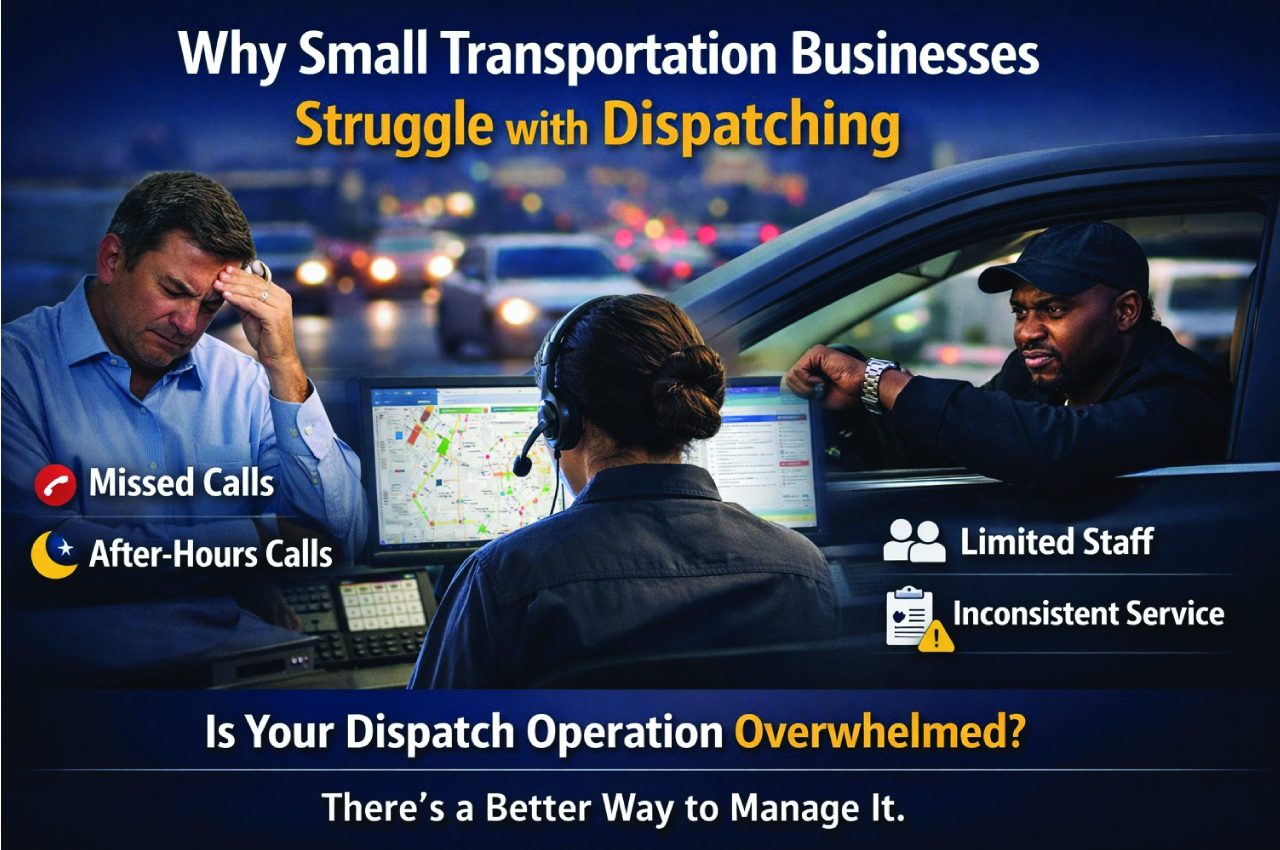
Running a small transportation business in the United States often feels like a balancing act. Owners are responsible for customer service, driver coordination, scheduling, billing, compliance, and growth often all at the same time. Among these responsibilities, dispatching is one of the most demanding and least forgiving.
Dispatching is not just about answering phones. It is about being available when customers need you, responding accurately under pressure, coordinating drivers in real time, and maintaining a consistent experience across every call. For many small transportation companies, this is where cracks begin to form.
Missed calls. Overworked staff. After-hours voicemails. Inconsistent service. These issues are not signs of poor management. They are symptoms of a system that has reached its limits.
This article explores why dispatching becomes such a persistent challenge for small transportation businesses and why many struggle to keep it efficient as they grow.
Dispatching Is More Than a Phone Call
Many business owners underestimate dispatching at the early stages. It often starts simply: a phone rings, a booking is taken, a driver is assigned. In the beginning, this system works because call volume is manageable and the owner or a small team can handle it personally.
But as the business grows, dispatching becomes more complex.
Calls start coming in at all hours. Customers expect immediate answers. Drivers need updates, changes, and confirmations in real time. A single missed call can mean a lost booking or a frustrated customer who never calls back.
Dispatching sits at the center of operations. When it functions well, everything runs smoothly. When it struggles, the effects ripple through the entire business.
Limited Staff, Unlimited Expectations
One of the biggest challenges small transportation businesses face is staffing. Unlike larger companies, small operators rarely have dedicated dispatch teams working around the clock.
In many cases, dispatching is handled by:
- The owner
- A single office staff member
- A rotating employee who also has other responsibilities
This setup creates immediate limitations.
People need breaks. They need sleep. They take days off. Yet customers expect availability at all times early mornings, late nights, weekends, and holidays.
When dispatching depends on a small number of people, coverage gaps are inevitable. Calls go unanswered. Messages pile up. Response times slow down.
These gaps are not always visible to the business owner, but customers feel them immediately.
After-Hours Coverage Is a Major Pain Point
Transportation does not operate on a standard nine-to-five schedule. Many bookings happen outside normal business hours, especially in industries like taxi services, limousine operations, and non-emergency medical transportation.
After-hours dispatching presents a difficult choice:
- Stay available at all times and risk burnout
- Let calls go to voicemail and risk lost business
Neither option is sustainable long-term.
Voicemail may seem harmless, but in reality, it creates friction. Customers often need immediate confirmation. If they cannot reach a live person, they may assume the service is unavailable and move on.
For small businesses, after-hours coverage is often inconsistent. Sometimes calls are answered. Sometimes they are not. This unpredictability erodes trust, even if the service itself is reliable.
Inconsistent Call Handling Hurts Customer Experience
Another common struggle is inconsistency.
When dispatching is handled by different people with varying levels of training, customers receive different experiences depending on who answers the phone.
One dispatcher may be calm, professional, and thorough. Another may sound rushed or uncertain. Booking details may be recorded differently. Important notes may be missed.
Customers notice these inconsistencies more than businesses realize.
A transportation company’s reputation is shaped not only by the ride itself, but by every interaction leading up to it. The phone call is often the first impression. If that impression feels disorganized, it raises doubts about reliability.
Consistency requires structure, training, and oversight resources that small teams often lack the time to develop internally.
Growth Increases Complexity, Not Just Volume
When a business grows, the natural assumption is that dispatching simply involves handling more calls. In reality, growth introduces complexity.
More drivers mean more coordination. More bookings mean more schedule changes. More customers mean more questions, updates, and special requests.
At a certain point, informal systems break down.
Spreadsheets become outdated. Verbal instructions get forgotten. Notes written during busy moments lack clarity. The margin for error shrinks, while expectations increase.
Small transportation businesses often reach a stage where demand is rising, but operational capacity cannot keep up. Dispatching becomes a bottleneck that limits further growth.
The Hidden Cost of Missed Calls
Missed calls are one of the most underestimated problems in small transportation businesses.
Each missed call represents:
- A potential booking
- A returning customer
- A referral opportunity
Customers rarely leave multiple messages. If they cannot reach someone live, they often call a different provider.
Missed calls also create internal stress. Staff feel pressured to return calls quickly while juggling other tasks. This leads to rushed conversations, errors, and frustration.
Over time, missed calls quietly drain revenue and damage customer trust—without appearing on any financial report.
Why Owners End Up Wearing Too Many Hats
In many small transportation companies, owners step in to fill dispatching gaps. They answer calls between meetings, late at night, or during personal time.
While this shows dedication, it creates long-term problems.
When owners handle dispatching themselves:
- Strategic work gets delayed
- Decision-making becomes reactive
- Burnout increases
Dispatching is operational work that demands constant attention. When owners are pulled into it, the business becomes dependent on them for daily survival rather than long-term direction.
This dependency makes scaling difficult and limits the company’s ability to operate independently.
Understanding White-Label Dispatching
White-label dispatching offers a different approach to handling these challenges.
In a white-label setup, dispatching and call handling are managed by an external team that operates entirely under the client’s company name. Customers never know the service is outsourced.
Calls are answered as if they are being handled in-house. Bookings are taken according to the company’s rules. Drivers are assigned following established procedures.
From the customer’s perspective, nothing changes except consistency and availability.
This model allows transportation businesses to maintain their brand identity while extending their operational capacity.
24/7 Coverage Without Internal Expansion
One of the most practical benefits of white-label dispatching is continuous coverage.
Instead of relying on a small internal team, businesses gain access to trained dispatchers who are available around the clock. Calls are answered live, even during nights, weekends, and holidays.
This eliminates coverage gaps without requiring:
- Hiring additional staff
- Managing shift schedules
- Paying overtime
The result is a steady, predictable dispatching operation that does not depend on individual availability.
Cost Control and Predictability
Hiring and retaining dispatch staff is expensive. Beyond salaries, there are costs related to training, turnover, supervision, and infrastructure.
White-label dispatching provides cost predictability. Businesses pay for a service rather than managing fluctuating internal expenses.
This model allows small transportation companies to control operational costs while maintaining service quality an especially important factor during periods of growth or uncertainty.
Consistency Across Every Call
Consistency is one of the most noticeable improvements businesses experience with professional dispatching support.
Calls are handled using standardized procedures. Information is collected accurately. Communication remains calm and professional, even during busy periods.
Customers receive the same experience whether they call in the morning or late at night. Drivers receive clear instructions. Fewer details are missed.
Consistency builds trust, and trust leads to repeat business.
Scalability Without Disruption
Growth should not force a business to rebuild its operations from scratch.
With white-label dispatching, increased call volume does not overwhelm internal systems. The dispatch operation scales quietly in the background, supporting expansion without disruption.
This allows owners and managers to focus on:
- Improving service quality
- Expanding coverage areas
- Strengthening driver relationships
Dispatching becomes a stable foundation rather than a constant concern.
A Quiet Advantage for Small Businesses
Dispatching struggles are common, but they are not inevitable.
Small transportation businesses face real constraints limited staff, unpredictable demand, and high customer expectations. These challenges do not reflect a lack of effort or commitment. They reflect the reality of running a service-based operation in a 24/7 environment.
By recognizing dispatching as a core operational function rather than an afterthought, businesses can make informed decisions about how to support it.
White-label dispatching is not about replacing internal teams or changing how a business presents itself. It is about reinforcing what already exists quietly, consistently, and professionally.
For many small transportation companies, the difference between struggling and scaling begins with how dispatching is handled.